Let me just come right out and say it: nobody in Japan loves the Utah Jazz more than I do. Waking or sleeping, outside of work — and, let’s be honest, during work — the Jazz are never far from my mind. Before the draft lottery I walk to my neighborhood shrine every weekend to pray for a high pick. In the offseason I pray that our players stay healthy and produce all year long. When those prayers are answered, I go back to give thanks and drop a generous offering in the box. That’s how much of my life the Jazz take up. I am Jazz Nation down to the marrow.
I started watching the NBA in the late 1980s, when Japan’s NHK satellite channel aired a game nearly every day. The first time I saw Magic Johnson, it knocked me sideways. The Larry Bird rivalry had me gripping the armrest. And then came Michael Jordan — “is this man even human?” — and I was gone. Completely taken.
The Jazz of that era finished middling and were, to my eye, a boring team playing boring basketball. But NHK posted the standings and the individual leaderboards after each broadcast, and I kept noticing the same two names: Malone near the top in points and rebounds, Stockton near the top in assists and steals. So I started paying attention whenever a Jazz game aired. And what did I find? They were running the same play, over and over and over, and scoring every time. “Why can’t anyone stop this? It’s the same action every time. It doesn’t even look like anything.” I taped the games and watched the replays again and again. Then I understood. These men were craftsmen. Master artisans. They executed the fundamentals at an astonishing level of precision, every single night. Isn’t that, in its own way, more remarkable than any one spectacular play? Before I knew it, they had me. The Jazz had become one of my teams.
Then came the news that detonated everything: in 1990, the NBA would play its official season opener in Japan for the first time. And my Jazz were coming. The opponent was Phoenix — Kevin Johnson, Tom Chambers and Jeff Hornacek, a three-headed Western rival. Our Jazz, meanwhile, had added Jeff Malone alongside the two pillars. This was going to be a great game, guaranteed. I was a student living in the provinces, but I splurged on a ¥20,000 ticket, flew to Tokyo, and went to Tokyo Metropolitan Gymnasium to cheer for Stockton and Malone. It was the second night of a back-to-back. We had lost the opener, so this one was a must-win.
My heart would not stop pounding. The players came out for warmups.
“There’s Stockton — THERE HE IS!!! Malone looks incredible!! WHOA!! Eaton is ENORMOUS!!”
A student’s excitement had nowhere left to climb. In those days you could walk right up to the court, so of course I went as close as the floor allowed and watched them warm up. When warmups ended and the players started heading off, fans lined up for autographs. And Malone — Malone actually stopped and started signing. I got in that line as fast as my legs would carry me. Karl worked through it steadily. My turn crept closer and closer. My heart was in my throat. And then, with two people left in front of me, Karl spun on his heel and vanished down the tunnel.
“Nicely done, Karl. Hitting me with the turnaround fadeaway.”
I may be the only Japanese person alive who has taken a live Karl Malone fadeaway.
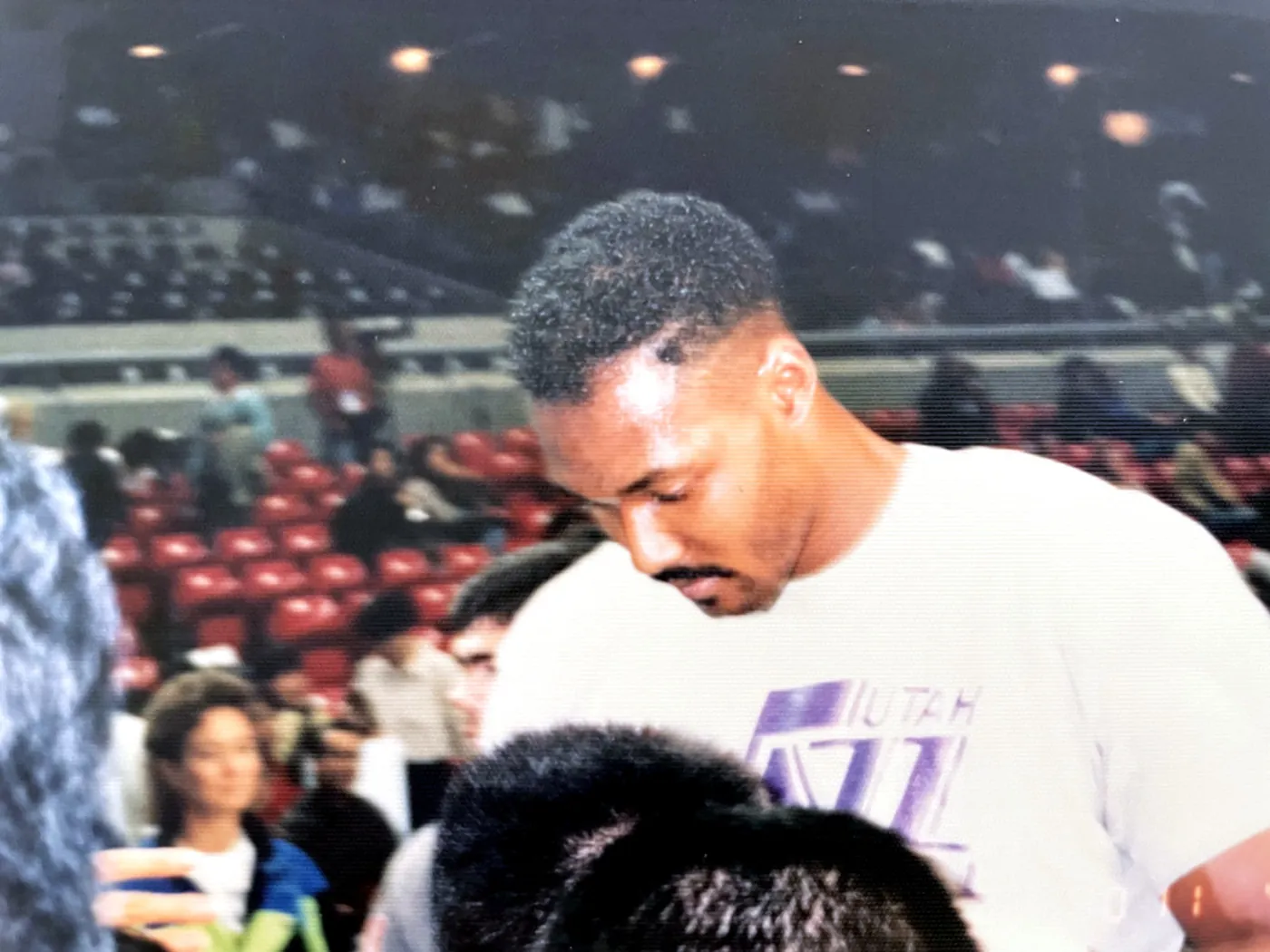
The game went back and forth and ended in a Jazz win. Stockton raised a fist to answer the crowd. The best possible game, the best possible result — and Karl’s fadeaway. Some time later a magazine ran interviews with the players. Karl: “At first, none of us wanted to go to Japan.” Hey! Stockton: “I honestly thought I might die” (he meant the travel). Come on, you two! Don’t you dare start disliking Japan. And somehow, even that — the two of them being that lukewarm about the whole trip — only made me love them more. That trip is where I became Jazz Nation for good. Getting Jazz games was another matter, though — NHK carried whatever the national US broadcast happened to be. I searched for a way around it and found a Swiss service called Pontel that would mail you every game of your chosen team on videotape, anywhere in the world. Around USD 50 a month, as I recall. I signed up on the spot. Now I could watch every last Jazz game. Then the internet arrived in the late 1990s, and — by that point Jazz Nation body and soul — I built a website to broadcast my love for this team and to find the other members of Jazz Nation here in Japan.
And then, in 1997, the Jazz reached the Finals for the first time. Against the mighty Chicago Bulls. Our Jazz had never been there before; surely they must be nervous. If I don’t go, they can’t win. It’s remarkable what a person can pull off when the feeling is strong enough. Working every connection I had made through that website, I got tickets to Games 3 and 4 at the Delta Center.
Game 3 ran about USD 1,400 for a reasonably good seat. Game 4 was around USD 300, last row. My salary at the time was miserable, so with airfare and everything else the trip cost me somewhere near a million yen. It hurt. But the Jazz won both games, and the expense repaid itself. Game 4 still gives me chills. I can replay it now. About fifty seconds left. Michael’s jumper is off. Stockton takes the rebound, puts it down once, and fires a one-handed arcing pass the length of the floor to Malone, who is already sprinting toward the far rim. The ball grazes Michael’s fingertips and finds Malone. Touchdown!! How were you already all the way down there, Karl?! And Johnny — how do you throw that pass, one-handed, that far, that accurate, and place it exactly where Michael can’t quite reach?! Seeing that pass live is a treasure I will carry for the rest of my life.
Sadly, the Jazz lost every game of that Finals except the two I attended in person. They returned the following year, but work made the Delta Center impossible; I cheered myself half to death in front of a television and it wasn’t enough. My beloved Jazz were reduced to a supporting role in Michael’s story. To this day, every tribute reel to Jordan uses those two Finals, and my chest tightens every time.
The Jazz eventually slipped past their peak. The era passed to D-Will and Boozer, and the Stockton and Malone I loved left the floor. With a hole opened up in my chest, I shut the website down. A stretch of working overseas, where I couldn’t watch the NBA at all, sent my Jazz fandom into dormancy. The pilot light came back on when Donovan Mitchell arrived — a flashy, genuinely charismatic star, the sort the Jazz had never had in my memory. The dull team was starting to change, and it became fun again. Even so, I never saw a future where Mitchell and Gobert won a championship. Then ownership passed from Larry Miller to Ryan Smith, Danny Ainge joined the front office, and the organization cut bait on that core, traded its stars, and entered a rebuild. Hiring head coach Will Hardy gave real reason for optimism. But four years of rebuilding is a long time. Worse, the early years produced middling records, which meant middling draft position. Taylor Hendricks lost essentially all of his second season to a major injury. Cody Williams was getting called a bust, of all things. In 2024-25 we tanked in earnest chasing Cooper Flagg, lost the lottery, and picked fifth. Up to that point there was no light at all.
Then, abruptly, things began to brighten. First: landing Ace Bailey at fifth. An extraordinary talent who, developed properly, becomes an All-Star. We lost the lottery, but we walked away with elite talent. That was the first light. The second was Keyonte George’s breakout. In his third season, 2025-26, he took an All-Star-caliber leap. His decision-making sharpened, his precision climbed, his emotional swings receded, and he became capable of patient basketball. I could suddenly see him as one wing of a future core. Then came the capstone: trading for Jaren Jackson Jr. The Jazz have had one of the worst defenses in the league, and no team contends without a defensive anchor. With a former Defensive Player of the Year in the building, there is light on that end too. Still, looking at San Antonio and Oklahoma City, it was obvious this wasn’t enough — we needed another true franchise cornerstone. And now, at last, we have him. Darryn Peterson. The Jazz have a genuine superstar candidate. Before the lottery I went to the shrine every weekend and prayed for a high pick, and we got the best possible outcome at number two. Before the draft I prayed for Peterson, and that was granted too. Watching him in Summer League, I became certain he will be a superstar. What a bright future this is! With Kessler gone there are pieces still missing, and the rebuild isn’t quite finished — but over the next three or four years, I can see us competing for an NBA championship.
I believe the coming 2026-27 season will be a New Chapter for the Jazz. And so I have decided to start broadcasting my love for this team again, in this form. This introduction has run very long. From here on I intend to write about the Jazz at a pace I can sustain, so please do stop by. The new chapter starts now!!
I hereby declare Keyonte George, Ace Bailey and Darryn Peterson the Triple Threat.
Key to Win!! Ace to Rule!! Darling(Darryn) to drive!!
A New Chapter Begins!!!
— The Admin
Comments
Even a single line about what you felt reading this would mean a lot.